



Published on Jan 22, 2026 by Jade
Narrative Paradigm Theory
By Jade Communications
“Stories are the most powerful way to put ideas into the world today.” - Robert McKee
Every day, we are surrounded by stories. Some unfold around the dinner table, some scroll past us on social media, and some play out in classrooms, boardrooms, or even on campaign trails. These stories shape what we believe, influence our decisions, and connect us to others. Communication scholar Walter Fisher captured this phenomenon in his Narrative Paradigm Theory, which shows that storytelling is at the heart of all meaningful communication.
What Is the Narrative Paradigm Theory?
The Narrative Paradigm is a communication theory that proposes all meaningful communication is storytelling. It challenges the traditional idea that persuasion relies primarily on logic and structured arguments. Instead, Fisher argues that humans are natural storytellers.
Rather than focusing solely on reason, facts, or evidence, Fisher introduces the concept of narrative rationality. People are not purely logical; we are guided by good reasons embedded in stories. These stories are judged on how coherent and relatable they are.
To determine whether a story is persuasive or meaningful, Fisher identifies two key criteria.
Coherence: How well does the story hold together internally? Is it consistent, logical, and believable?
Fidelity: Does the story resonate with our experiences, values, and beliefs? Stories with high fidelity feel authentic and trustworthy, even without heavy reliance on statistics.
Why does the Narrative Paradigm Theory Matter In communication?
People don’t receive messages in a vacuum. We interpret and evaluate new information through the lens of the stories we already know, the lives we’ve lived, the values we hold, and the communities we belong to. Fisher’s theory offers several insights that apply across professional fields.
First, everyone is a storyteller. The Narrative Paradigm democratizes communication by asserting that all people can create and interpret stories.
Second, stories carry moral weight. Audiences evaluate whether a story feels “true” in alignment with their understanding of the world.
Third, storytelling is strategic. Effective storytelling is deliberate. It involves structure, intention, emotion, and timing.
Finally, emotion and logic are not separate. A story can simultaneously move hearts and also frame decision.
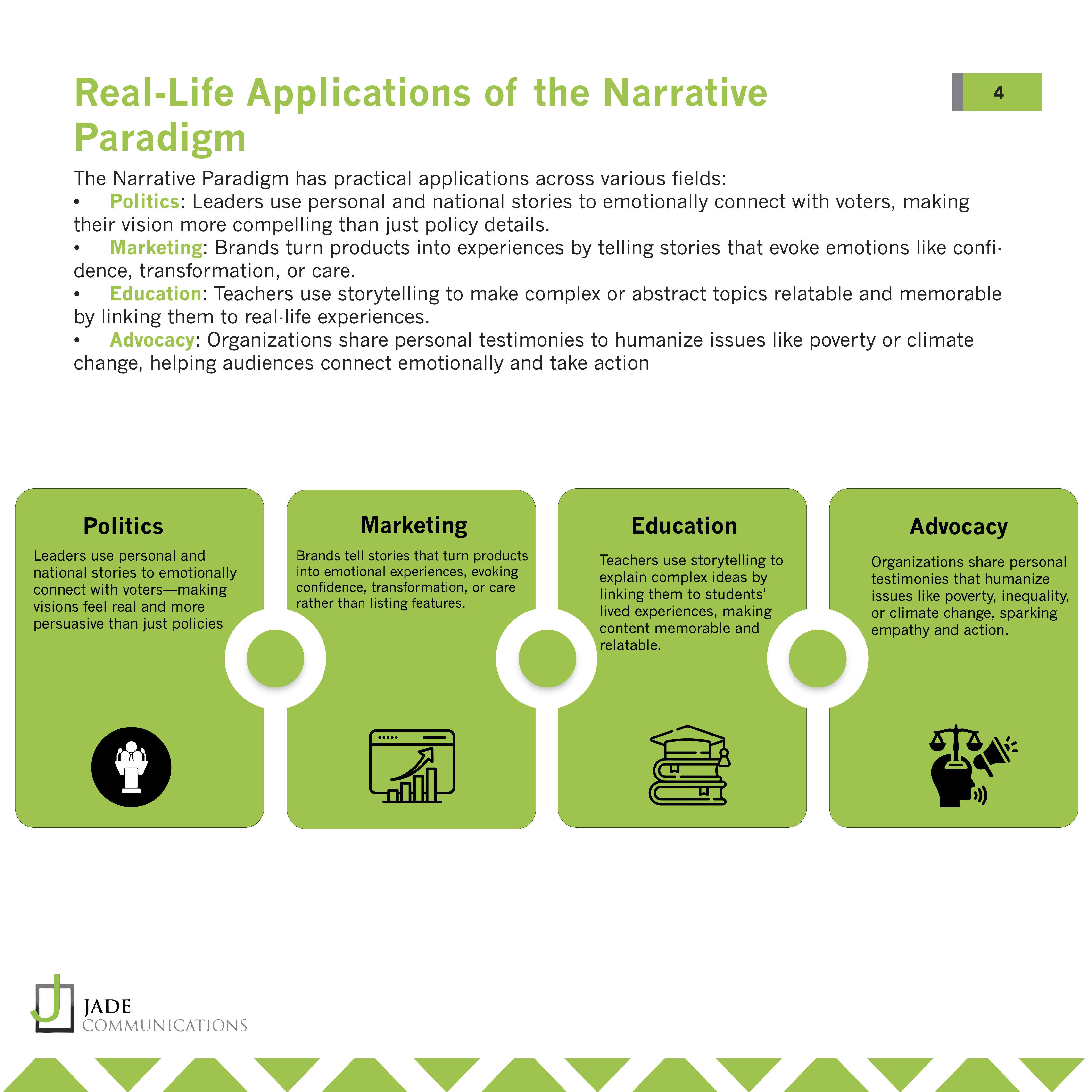
Real-Life Applications of the Narrative Paradigm
The principles of the Narrative Paradigm are not confined to a theory; they are actively shaping real-world communication every day.
In politics, leaders often craft narratives around their upbringing, personal struggles, or national identity to connect with voters on an emotional level. It’s not just the policies that matter it's the story behind the vision that draws people in.
In marketing, successful brands use storytelling to turn products into experiences. A skincare company doesn’t just sell lotion it tells the story of confidence, transformation, and care, making the product feel like a solution to a shared human need.
In education, teachers use storytelling to make abstract concepts come alive. A history teacher, for instance, may humanize major events by telling the story of one family or child who lived through them, making lessons more memorable.
In advocacy, organizations share personal testimonies to draw attention to broader issues, like poverty, injustice, or climate change. These stories help donors, communities, and policymakers see the human face behind the statistics.
How can You Apply Narrative Paradigm Theory?
Though the Narrative Paradigm was born in academic theory, its real power lies in practice. You’ll find it at work in campaign trails, community meetings, boardrooms, classrooms, and even dinner table conversations. It reminds us that people connect with meaning.
Applying the Narrative Paradigm means going beyond data to highlight human experience by sharing examples that feel personal and true. It means recognizing that how you tell the story and who tells it can be just as important as the story itself.
What are the Benefits of Applying Narrative Paradigm Theory?
Applying Narrative Paradigm Theory brings several benefits to communication by making messages more engaging, relatable, and memorable. Stories naturally capture attention and hold it longer than abstract arguments, allowing ideas to resonate on an emotional as well as an intellectual level. They build trust and credibility when they feel authentic. Narratives also make complex concepts easier to understand by framing them in familiar, human terms. In group or community settings, storytelling strengthens shared values and identity, creating a sense of unity and purpose. Most importantly, it inspires action, by helping people to see themselves within the story and feel part of its outcome.
Additional Content
Sticky right
Related Blogs

Effective Communication is Crucial in the Success of the Northern Corridor Project.
Jul 17, 2025
A mile above sea level, the thin Mombasa air refreshed delegates representing the governments of Rwa...
Read More
The Role of Women in Diplomacy
May 25, 2025
Today’s world faces a myriad of challenges. In the diplomatic field, the global landscape is complex...
Read More
Best and Worst Communicators and Moments of 2021
Jul 18, 2025
2021 was the second year of the Covid-19 pandemic and some of the best communicators were medical pr...
Read More